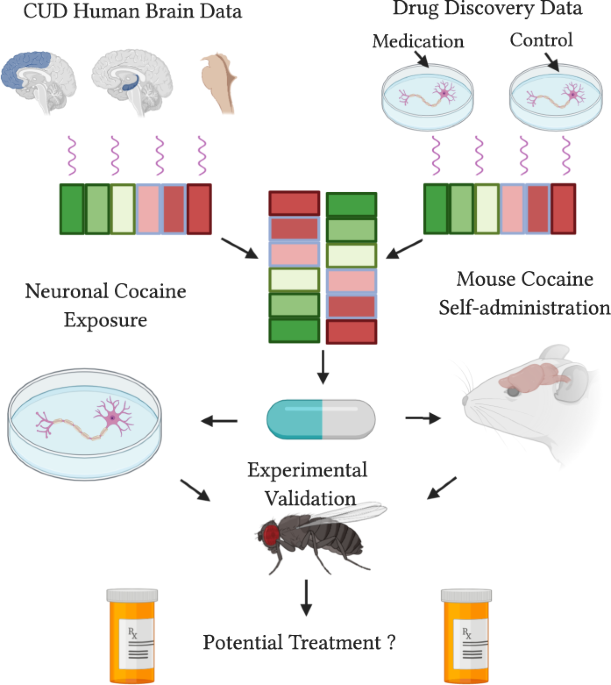
1.United Nations Publication SNE 19. X 8. World drug report. United Nations Publication; 2019.2.SAMSHA. Key Substance Use and Mental Health Indicators in the United States: Results from the 2018 National Survey on Drug Use and Health. 2019.3.Turner C, Chandrakumar D, Rowe C, Santos G, Riley D, Coffin PO. Cross-sectional cause of death comparisons for stimulant and opioid mortality in San Francisco, 2005–2015. Drug Alcohol Depend. 2019;185:305–12.Article Google Scholar 4.National Institute on Drug Abuse [Internet]. Trends & Statistics: Overdose death rates [updated Jan 29 2021; cited Feburary 5, 2021]. Available from: https://www.drugabuse.gov/drug-topics/trends-statistics/overdose-death-rates.5.Dutra L, Stathopoulou G, Basden SL, Leyro TM, Powers MB, Otto MW. A meta-analytic review of pyschosocial interventions for substance use disorders. Am J Pyschiatry. 2006;14:3989–96. Google Scholar 6.Chan B, Kondo K, Freeman M, Ayers C, Montgomery J, Kansagara D. Pharmacotherapy for cocaine use disorder—a systematic review and meta-analysis. J Gen Intern Med. 2017;24:2858–2873. Google Scholar 7.Vroegop MP, Franssen EJ, Voort PHJ, van den Berg TNA, Langewag RJ, Kramers C. The emergency care of cocaine intoxications. Neth J Med. 2009;67:122–126.CAS Google Scholar 8.Chen H, Albertson TE, Olson KR. Treatment of drug-induced seizures. Br J Clin Pharm. 2015;81:412–9.Article Google Scholar 9.Narasimhan D, Woods JH, Sunahara RK. Bacterial cocaine esterase: a protein-based therapy for cocaine overdose and addiction. Future Med Chem. 2012;4:137–50.CAS Article Google Scholar 10.Ribeiro EA, Scarpa JR, Garamszegi SP, Kasarskis A, Mash DC, Nestler EJ. Gene network dysregulation in dorsolateral prefrontal cortex neurons of humans with cocaine use disorder. Sci Rep. 2017;7:1–10.Article Google Scholar 11.Zhou Z, Yuan Q, Mash DC, Goldman D. Substance-specific and shared transcription and epigenetic changes in the human hippocampus chronically exposed to cocaine and alcohol. Proc Natl Acad Sci. 2011;108:6626CAS Article Google Scholar 12.Bannon MJ, Johnson MM, Michelhaugh SK, Hartley ZJ, Halter SD, David JA, et al. A molecular profile of cocaine abuse includes the differential expression of genes that regulate transcription, chromatin, and dopamine cell phenotype. Neuropsychopharmacology. 2014;39:2191–9.CAS Article Google Scholar 13.Ferguson LB, Ozburn AR, Ponomarev I, Metten P, Reilly M, Crabbe JC, et al. Genome-wide expression profiles drive discovery of novel compounds that reduce binge drinking in mice. Neuropsychopharmacology. 2018;43:1257–66.Article Google Scholar 14.Nosengo N. New tricks for old drugs. Nature 2016;534:314–6.Article Google Scholar 15.Subramanian A, Narayan R, Corsello SM, Root DE, Wong B, Golub TR, et al. A next generation connectivity map: L1000 platform resource. Cell. 2017;171:1437–e17.CAS Article Google Scholar 16.Huggett SB, Stallings MC. Genetic architecture and molecular neuropathology of human cocaine addiction. J Neurosci. 2020;40:5300–13.CAS Article Google Scholar 17.Huggett SB, Stallings MC. Cocaine’omics: Genome‐wide and transcriptome‐wide analyses provide biological insight into cocaine use and dependence. Addict Biol. 2019;25:1–10. Google Scholar 18.Viechtbauer W. Conducting meta-analyses in R with the metafor Package. J Stat Softw. 2010;36:1–48.Article Google Scholar 19.Fernandez-Castillo N, Cabana-Dominguez J, Soriano J, Sanchez-Mora C, Roncero C, Grau-Lopez L, et al. Transcriptomic and genetic studies identify NFAT5 as a candidate gene for cocaine dependence. Transl Psychiatry. 2015;5:1–9.Article Google Scholar 20.Walker DM, Cates HM, Loh YE, Purushothaman I, Ramakrishnan A, Cahill KM, et al. Cocaine self-administration alters transcriptome-wide responses in the brain’s reward circuitry. Biol Psychiatry. 2018;84:867–80.CAS Article Google Scholar 21.Highfill CA, Baker BM, Stevens SD, Anholt RRH, Mackay TFC. Genetics of cocaine and methamphetamine consumption and preference in Drosophila melanogaster. PLoS Genet. 2019;15:e1007834.CAS Article Google Scholar 22.Kaun KR, Devineni AV, Heberlein U. Drosophila melanogaster as a model to study drug addiction. Hum Genet. 2012;131:959–75.CAS Article Google Scholar 23.Wang KH, Penmatsa A, Gouaux E. Neurotransmitter and psychostimulant recognition by the dopamine transporter. Nature. 2015;521:322–7.CAS Article Google Scholar 24.Mcclung C, Hirsh J. Stereotypic behavioral responses to free-base cocaine and the development of behavioral sensitization in Drosophila. Curr Biol. 1998;8:109–12.CAS Article Google Scholar 25.Filošević A, Al-samarai S, Andreti R. High throughput measurement of locomotor sensitization to volatilized cocaine in Drosophila melanogaster. Front Mol Neurosci. 2018;11:1–12.Article Google Scholar 26.de Claro RA, McGinn KM, Verdun N, Lee SL, Chiu HJ, Saber H, et al. FDA Approval: Ibrutinib for patients with previously treated mantle cell lymphoma and previously treated chronic lymphocytic leukemia. Clin Cancer Res. 2015;1:3586–91.Article Google Scholar 27.Dolgin E. BTK blockers make headway in multiple sclerosis. Nat Biotechnol. 2021;39:3–5.CAS Article Google Scholar 28.Merolle MI, Ahmed M, Nomie K, Wang ML. The B cell receptor signaling pathway in mantle cell lymphoma. Oncotarget. 2018;9:25332–41.Article Google Scholar 29.Northcutt AL, Hutchinson MR, Wang X, Baratta MV, Hiranita T, Cochran TA. et al. DAT isn’t all that: cocaine reward and reinforcement require Toll-like receptor 4 signaling. Mol Psychiatry. 2015;20:1525–1537.CAS Article Google Scholar 30.Volkow ND, Fowler JS, Wang GJ, Hitzemann R, Logan J, Schlyer DJ, Dewey SL, Wolf AP. Decreased dopamine D2 receptor availability is associated with reduced frontal metabolism in cocaine abusers. Synapse 1993;14:169–77.CAS Article Google Scholar 31.Smith RJ, Aston-jones G. Alpha-2 adrenergic and imidazoline receptor agonists prevent cue-induced cocaine-seeking. Biol Psychiatry. 2011;70:712–9.CAS Article Google Scholar 32.Vandergriff J, Kallman MJ, Rasmussen K. Moxonidine, a selective imidazoline-1 receptor agonist, suppresses the effects of ethanol withdrawal on the acoustic startle response in rats. Biol Psychiatry. 2000;47:874–9.CAS Article Google Scholar 33.Taksande BG, Kotagale NR, Patel MR, Shelkar GP, Ugale RR, Chopde CT. Agmatine, an endogenous imidazoline receptor ligand modulates ethanol anxiolysis and withdrawal anxiety in rats. Eur J Pharm. 2010;637:89–101.CAS Article Google Scholar 34.Le Foll B, Di Ciano P, Panlilio LV, Goldberg SR, Ciccocioppo R. Agonists as promising new medications for drug addiction: evidence. Curr Drug Targets. 2013;14:768–76.Article Google Scholar 35.Zhong P, Wang W, Yu F, Nazari M, Liu X, Liu Q. Phosphodiesterase 4 inhibition impairs cocaine-induced inhibitory synaptic plasticity and conditioned place preference. Neuropsychopharmacology. 2012;37:2377–87.CAS Article Google Scholar 36.Olsen CM, Liu Q, Road P. Phosphodiesterase 4 inhibitors and drugs of abuse: current knowledge and therapeutic opportunities. Front Biol. 2017;11:376–86.Article Google Scholar 37.Satta R, Certa B, He D, Lasek AW. Estrogen receptor β in the nucleus accumbens regulates the rewarding properties of cocaine in female mice. Int J Neuropsychopharmacol. 2018;21:382–92.CAS Article Google Scholar 38.Mccall NM, Kotecki L, Dominguez-lopez S, Marron E. Velasco F De, Carlblom N, et al. Selective ablation of GIRK channels in dopamine neurons alters behavioral effects of cocaine in mice. Neuropsychopharmacology. 2017;42:707–15.CAS Article Google Scholar 39.Siciliano CA, Jones SR. Cocaine potency at the dopamine rransporter tracks discrete motivational states during cocaine self-administration. Neuropsychopharmacology. 2017;42:1893–904. https://doi.org/10.1038/npp.2017.24.CAS Article PubMed Central Google Scholar 40.Sadakierska-Chudy A, Frankowska M, Filip M. Mitoepigenetics and drug addiction. Pharmacol Therapeutics. 2014;144:226–33. 1CAS Article Google Scholar 41.Paydas S. Management of adverse effects/toxicity of ibrutinib. Crit Rev Oncol/Hematol. 2019;136:56–63.Article Google Scholar Page 2This schematic outlines the stages of the study from drug discovery (top), to computational follow-up (middle) and in-vivo validation (bottom).
https://www.nature.com/articles/s41398-021-01737-5
Ibrutinib as a potential therapeutic for cocaine use disorder