
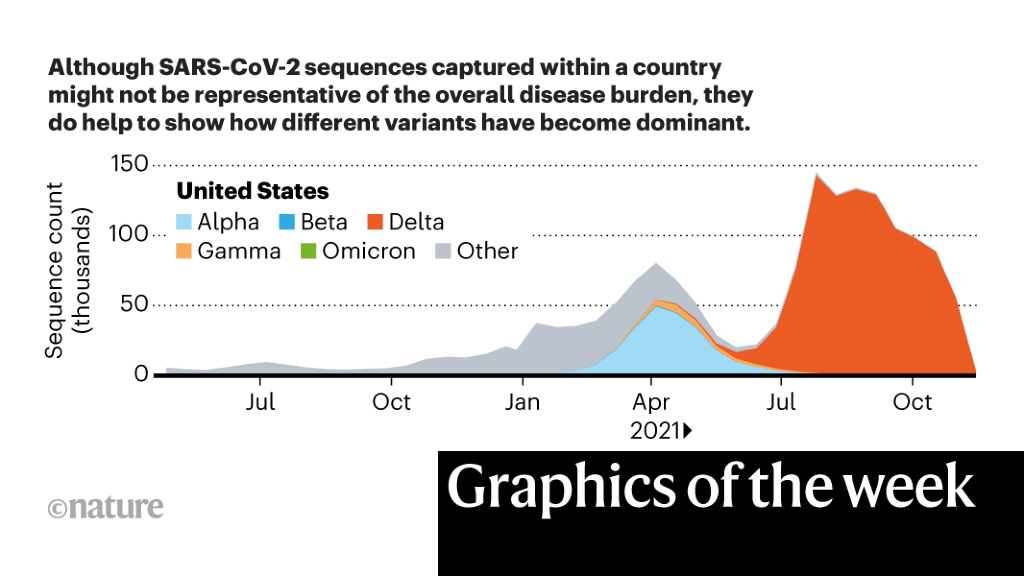
How SARS-CoV-2, the virus that causes COVID-19, evolves over the next several months and years will determine what the end of the pandemic will look like. An early variant, now known as Alpha, spread at least 50% faster than earlier circulating lineages. Along with two other variants — Beta and Gamma — it spread around the world. The Delta variant was identified in India in the spring of 2021. Once it arrived in the United Kingdom, Delta spread quickly and was found to be about 60% more transmissible than Alpha. Delta and its descendants now account for the vast majority of COVID-19 cases worldwide, and researchers expected these Delta lineages to eventually outcompete the last holdouts. But Omicron has undermined those predictions. Teams in Botswana and South Africa identified this variant in late November — although researchers say it is unlikely to have originated in either country — and scientists worldwide are working to gauge the threat that it poses. Source: Covariants.org
Webb telescope prepares for launchSome three decades in planning, NASA’s James Webb Space Telescope (JWST) is finally about to launch. It is scheduled to lift off from a launch pad in Kourou, French Guiana, no earlier than 22 December. If everything goes to plan, Webb will remake astronomy by peering at cosmic phenomena such as the most distant galaxies ever seen, the atmospheres of far-off planets and the hearts of star-forming regions swaddled in dust. Roughly 100 times more powerful than its predecessor, the Hubble Space Telescope, Webb will reveal previously hidden aspects of the Universe, studying light that has travelled from faraway galaxies. Graphic: Nik Spencer/Nature; ‘Cold telescope’ main image: NASA GSFC/CIL/Adriana Manrique Gutierrez
Drought in BrazilAlthough Brazil has the largest amount of fresh water in the world, much of the nation now faces drought. Between March and May this year, dry weather in the south-central region led to a 267-cubic-kilometre shortage of water held in rivers, lakes, soil and aquifers, compared with the seasonal average for the past 20 years. Many major reservoirs have reached less than 20% capacity. Farming and energy generation have been hit. Since July, coffee prices have risen by 30%. Soya bean prices rose by 67% from June 2020 to May this year. And electricity bills have soared by 130%. Many cities face imminent water rationing. A group of 95 Brazilian and international water and climate scientists is now calling for a coordinated nationwide drought-mitigation plan to address the problem. Source: H. Save et al. J. Geophys. Res. Solid Earth 121, 7547–7569 (2016)
doi: https://doi.org/10.1038/d41586-021-03694-x SARS-CoV-2 Astronomical instrumentation Environmental sciences
https://www.nature.com/articles/d41586-021-03694-x
