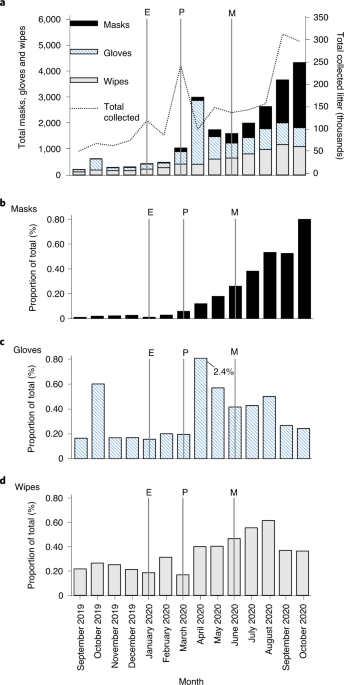
Increased personal protective equipment litter as a result of COVID-19 measures Use of personal protective equipment (PPE) increased during the COVID-19 pandemic to reduce virus transmission. Here, we quantitatively analyse emergence of PPE and COVID-19-related litter over 14 months for 11 countries using the litter collection application Litterati. The proportion of masks in litter increased by >80-fold as a result of COVID-19 legislation, from 0.8%. Gloves and wipes, more prevalent at ~0.2% of litter before the pandemic, doubled to 0.4%, but this has since fallen. Glove litter increased in the initial stages of the pandemic but fell after the introduction of facemask policies, whereupon there was an increase of facemask litter. National COVID-19 policy responses and international World Health Organization announcements and recommendations are a probable driver of PPE litter dynamics, especially the implementation of facemask policies. Waste management should be incorporated in designing future pandemic policies to avoid negative environmental legacies of mismanaged PPE. Public attention during the COVID-19 pandemic has understandably focused on human health but there is now evidence that society’s response is leading to environmental impacts that will last well beyond the pandemic1,2. Since the World Health Organization (WHO) announced a global health emergency on 30 January 2020, there has been an unprecedented increase in demand and use of personal protective equipment (PPE) to reduce virus transmission3. Nations and regions have adopted different policy responses to the use of social or physical distancing measures and the wearing of masks or face coverings (herein referred to collectively as masks) within their populations. Most authorities instigated restrictions on workplaces within days of the WHO announcement, with national guidance on mask use generally announced around the same time as the WHO advice. However, masks and other PPE items are increasingly found as litter4,5 and the use of materials such as plastic in these items represents a global environmental challenge6.PPE is used by health professionals to prevent infection and contamination, and when required in non-medical workplaces (for example, construction, carpentry, painting and decorating, laboratories and food processing)7,8. These are often single-use items manufactured from polymeric materials designed to be disposed of within either medical/hazardous or general waste depending on their level of contamination9,10. Within certain regions there has been a socially established practice of wearing masks in non-medical settings to help prevent the spread of infection11 with their main purpose to serve as ‘source control’12,13,14.Throughout the initial stages of the pandemic (February to May 2020), anecdotal reports emerged of increased littering of masks and personal cleaning products such as wipes (for example, disinfectant wipes/wet wipes) and gloves4,9,15,16,17. Restrictions on movements across the globe (lockdowns) presented challenges for scientists in quantifying the reported environmental impacts of COVID-19-related litter including the potential impact of policies. We have therefore used data collected by the public before and during the pandemic to enable an analysis of changes in behaviours during the initial stages of the pandemic4,18,19,20,21. Pre-pandemic waste management practices and infrastructure were predominate throughout the initial months of the pandemic, resulting in difficulties in waste treatment/collection10,22. Increasing concern about the potential health and environmental impacts of mismanaged PPE began to increase after the pandemic announcement4,23,24To investigate the changing patterns of PPE litter during a pandemic, we present a multicountry analysis of the emergence of COVID-19-related litter and relate it to timings of national policies and WHO recommendations for 11 nations (Australia, Belgium, Canada, France, Germany, the Netherlands, New Zealand, Spain, Sweden, the United Kingdom and the United States). First, we report the time series observations from September 2019 to the end of October 2020 from citizen science data on the presence of key COVID-19-related litter of masks, gloves and wipes at national and international scales. Second, we correlate these patterns to the timing of international pandemic announcements from the WHO and national-level mask and lockdown regulations to identify pandemic-related policies on the presence of PPE in litter.Our method used existing data within the crowd-based, citizen science application Litterati to enable an analysis of littering behaviour and the proportional composition of COVID-19-related litter18. These applications enable a rapid collection of data across a dispersed environment without compromising data quality and, in this instance, enabled retrospective analysis of collected data23,25,26. This allowed the observation of phenomena and collection of data on scales previously restricted to localized case studies or requiring substantial investment in research methodologies19. Litterati was selected for its temporal and geographic coverage, preventing possible double counting if other additional litter debris applications were used. The data analysed here cover the period September 2019 (6 months before the pandemic announcement) to October 2020. Items were classified as: (1) masks, (2) gloves and (3) wipes (Fig. 1). This general classification was used due to complexity of littered items tags (in excess of 90,000).Fig. 1: Total collected litter per month for all countries analysed and total proportion of masks, gloves and wipes of the total collected litter.a, Total collected litter refers to all litter tagged with total counts for masks, gloves and wipes. b–d, Masks (b), gloves (c) and wipes (d) as proportions of the total collected litter. Vertical grey lines denote the month of the WHO declarations and guidance: E, emergency; P, pandemic; and M, general mask use recommended.In the 4 months before the WHO announced a health emergency (Fig. 1) the quantities of masks, gloves and wipes collected remained stable with the proportion of masks at 5% of all litter, with gloves and wipes present at ~1.5% respectively. Other countries showed different patterns of COVID-19-related litter proportions, with several showing little change before and after the pandemic announcements. In the Netherlands, for example, the proportion of masks, gloves and wipes does not exceed 1% of the total tagged litter, except for gloves, which reached 3% in April 2020. Sweden had many months when no COVID-19-related litter was recorded. Canada shows an emergence of mask, glove and wipe litter around and after the announcement of a pandemic, with Germany and the United States having a similar response for masks but gloves and wipes were present as litter before the pandemic.Intercountry differences in COVID-19-related litter are observed for all litter types examined. The exponential increase in proportion of masks in the United Kingdom matches the general pattern of change (Fig. 2) but its timing was a month behind the WHO’s announcement of the pandemic.The impact of pandemic-related policies on litterCOVID-19 emerged and spread rapidly in December 2019, with differing international responses throughout the timespan used in this study (Fig. 3). Time of instigation and severity of these national-level interventions, along with WHO advice, created a complicated variation of conditions for different nations.Fig. 3: Government response to the COVID-19 pandemic.Each bar represents the scale of response: 1 (green), recommend closing (or work from home); 2 (orange), require closing (or work from home) for some businesses (for example, restaurants and theatres); and 3 (red), require closing (or work from home) of all but essential workplaces (for example, grocery stores and doctors). All government responses allowed essential services to remain open. Vertical lines show the WHO declarations and advice for a global emergency, global pandemic and global advice to use masks/coverings. Red diamonds indicate when a country required mask use and green circles indicate when countries recommended mask use.The Oxford University Coronavirus Government Response Tracker24 categorized government responses on a four-point scale (Methods). While some countries recommended closing and working from home (for example, the United Kingdom and the Netherlands), a typical response has been to require all but essential workplaces to close in favour of home working (level 3 response). Sweden did not implement mandatory closures or the usage of masks throughout the duration of the pandemic (Fig. 3), while Australia and New Zealand only required these in June/July of 2020 when new cases rose after the initial response had been largely lifted. As of October 2020, most countries had a level 2 response in place except for Sweden, Australia and New Zealand. The different levels of governmental response, in turn, had unintended consequences in relation to litter composition as has been widely reported15.National policies impact on COVID-19-related litterThe two main types of national policies that we investigated as having potential impacts on COVID-19-related litter were the introduction of mask-wearing policies and ‘lockdown’ travel restrictions.The introduction of mask-wearing policies had a clear impact on PPE litter dynamics (Fig. 4). Masks show the greatest response with ~0.01% on average before legislation but increasing thereafter. Gloves show an increase 2 months before legislation, instead aligning with the WHO’s announcements and advice (Fig. 1) but decreasing after national-level mask-wearing policies. Wipes levels are variable throughout the study period, highlighting the difference in littering behaviours between nations.Fig. 4: Data scaled to the month nations implemented compulsory mask use (month 0) for the percentage proportion of masks, gloves and wipes within the total collected litter.Sweden never legislated for mask use and is excluded from this data set. Boxes show interquartile ranges; horizontal lines in boxes are medians; vertical lines are 95% limits; dots are outliers.For masks and gloves, there were significant differences between the categories following the WHO advice, lockdown level and national mask laws (Kruskal–Wallis tests all P < 0.01; see Supplementary Table 3 and Fig. 5).Fig. 5: Effects of WHO advice, lockdown level and national mask laws on littering of masks, gloves and wipes.Relationship of national mask guidance/legislation (0, no legislation; 1, masks recommended; 2, masks required), workplace lockdown level (0, no lockdown restrictions; 1, recommend work from home; 2, work from home where possible with some workplaces closed; 3, all non-essential business closed with work from home mandatory) and the WHO announcements and guidance on the proportion of mask, glove and wipe litter to the total collected. Boxes show interquartile ranges; horizontal lines in boxes are medians; vertical lines are 95% limits and circles are outliers. A star in the left corner denotes P 0.72% and national mask legislation appearing to be the most consistent underlying factor (Fig. 5). As nations legislating mask use increased, masks also increased as a percentage of litter over time. Compulsory use of masks has a significant impact on wipe littering (P < 0.01), whereas gloves show a decrease suggesting other factors are associated with glove littering.Littered wipes generally show
https://www.nature.com/articles/s41893-021-00824-1
Increased personal protective equipment litter as a result of COVID-19 measures