
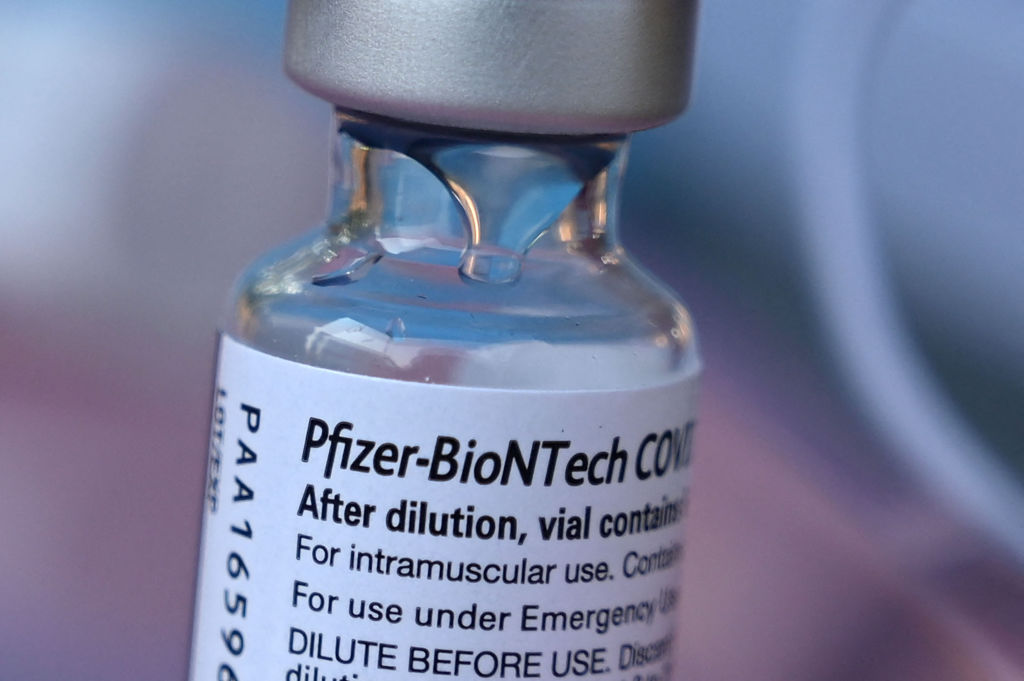
The Pfizer/BioNTech Covid-19 vaccine offers some protection against the new omicron variant, but people might need to get three shots instead of just two to get the same level of protection, based on preliminary results from lab tests conducted by the companies. A fuller picture of the level of protection offered by the messenger RNA vaccine, and whether an omicron-specific version is needed, awaits more data from real-world studies. Speaking during a Wednesday press conference, BioNTech CEO Ugur Sahin said that that while previous variants have mutations ranged from 10 to 15 in number, omicron exhibits 34 to 35 mutations. Many of those mutations are on a part of the spike protein called the receptor binding domain—the part of that binds to a protein on the surface of a cell in order to enter it, Sahin said.
Some of omicron’s mutations are shared with other variants of the novel coronavirus. That means that the current version of the Covid-19 vaccine still has an effect, but preliminary data suggest it’s a diminished one. BioNTech has not yet published data that can be peer reviewed. In its Wednesday announcement of the preliminary lab data, BioNTech said it tested blood samples from people one month after receiving a booster—a third shot that followed the initial two-shot vaccination series. According to the company, the average levels of neutralizing antibodies against omicron was reduced by more than 25-fold, indicating that two doses may not provide sufficient protection against the new variant.
In addition to prompting the immune system to produce neutralizing antibodies, Covid-19 vaccines also lead to T cell responses. Memory T cells are particularly important as these cells remain long after an infection and stand ready to respond quickly if the pathogen returns. BioNTech Chief Medical Officer Ozlem Türeci said that the presence of these memory T cells may still protect against severe disease from the omicron variant. BioNTech expects that two doses may offer protection against severe disease, however, a third dose of may be needed to get the protection offered by neutralizing antibodies. Türeci added that these preliminary data ‘shows us that the first line of defense with two doses of vaccination might be compromised and three doses of vaccination are required to restore protection.’
A variant evaluation study began nine months ago in preparation for a potential change in the vaccine, Sahin said. Clinical trials are ongoing against the beta, delta, and alpha variants. Yet another clinical trial is evaluating a vaccine that protects against both the alpha and delta variants. In tests against the beta variant, the reduction in levels of neutralizing antibodies was fivefold. Sahin said that these results suggest omicron is a much stronger neutralizing antibody escape variant.
‘It is still not a complete escape variant; it is a partial escape variant,’ he said. ‘That means the virus can be neutralized by high titers of neutralizing antibodies.’
According to the company, the preliminary data suggest that a booster of the current messenger RNA vaccine increases antibody levels by 25-fold. That additional shot also increases the levels of T cells that respond to multiple parts of the spike protein that attach to an antibody, which can offer additional protection. Most of these parts are unchanged in the omicron variant, according to the company.
Sahin said that BioNTech is continuing to develop an omicron-specific vaccine, if needed. Whether that vaccine is needed will depend on data from real-world studies that show how quickly omicron is spreading as well as the effectiveness of the current vaccine against the new variant. Getting those data could take another six to eight weeks, Sahin said.
Omicron was first identified in South Africa last month. An omicron-specific version of the Pfizer/BioNTech vaccine has already been designed; if it turns out it is needed, that vaccine can be ready for delivery by March, pending regulatory authorizations, Sahin said. He added that vaccine for the omicron variant should be a three-dose vaccine. That vaccine could also offer protection against more than one variant. Sahin noted that the variant clinical trials underway have already shown that a multivalent vaccine can be produced, but more data are needed to determine whether such a change is necessary.
Photo: Robyn Beck/AFP, via Getty Images
https://medcitynews.com/2021/12/biontech-ceo-omicron-is-partial-escape-variant-but-booster-may-restore-protection/
